
CONTINUING EDUCATION
Body Harmonics Pilates Teacher Training is a comprehensive program designed to equip individuals with the knowledge, skills, and techniques necessary to become a certified and successful Pilates instructor. The program provides a comprehensive learning experience that combines the fundamentals of anatomy, kinesiology, and exercise science with the unique Body Harmonics Pilates Method. We offer many different continuing education courses to help Pilates instructors be their best. Learn more about Pilates teacher training courses below, and sign up today!
Balance Apparatus: Pilates Props with Purpose
CECs: 6 | Tuition: $275
This course focuses on three pieces of equipment: foam roller, swivel discs and stability ball. Simple, portable and versatile, each piece of apparatus adds challenge and depth to classes and one-on-one sessions. Learn to rebalance and create both deep and superficial support in the hips, shoulders and upper torso. Build exercise sequences from simple to complex and from relatively stable to extremely unstable. Equipped with both conceptual and kinesthetics understanding, you leave this course ready to teach core stability and balance training in a way that engages the body in every plane and direction.
Learning Objectives
Learn how to use balance apparatus for safe and effective outcomes
Practise exercises using a stability ball, foam roller and swivel discs
Experience the continuum that training with balance apparatus provides: improved balance, increased core control and optimal joint mobility
Anatomy for Motion
CECs: 6 | Tuition: $275
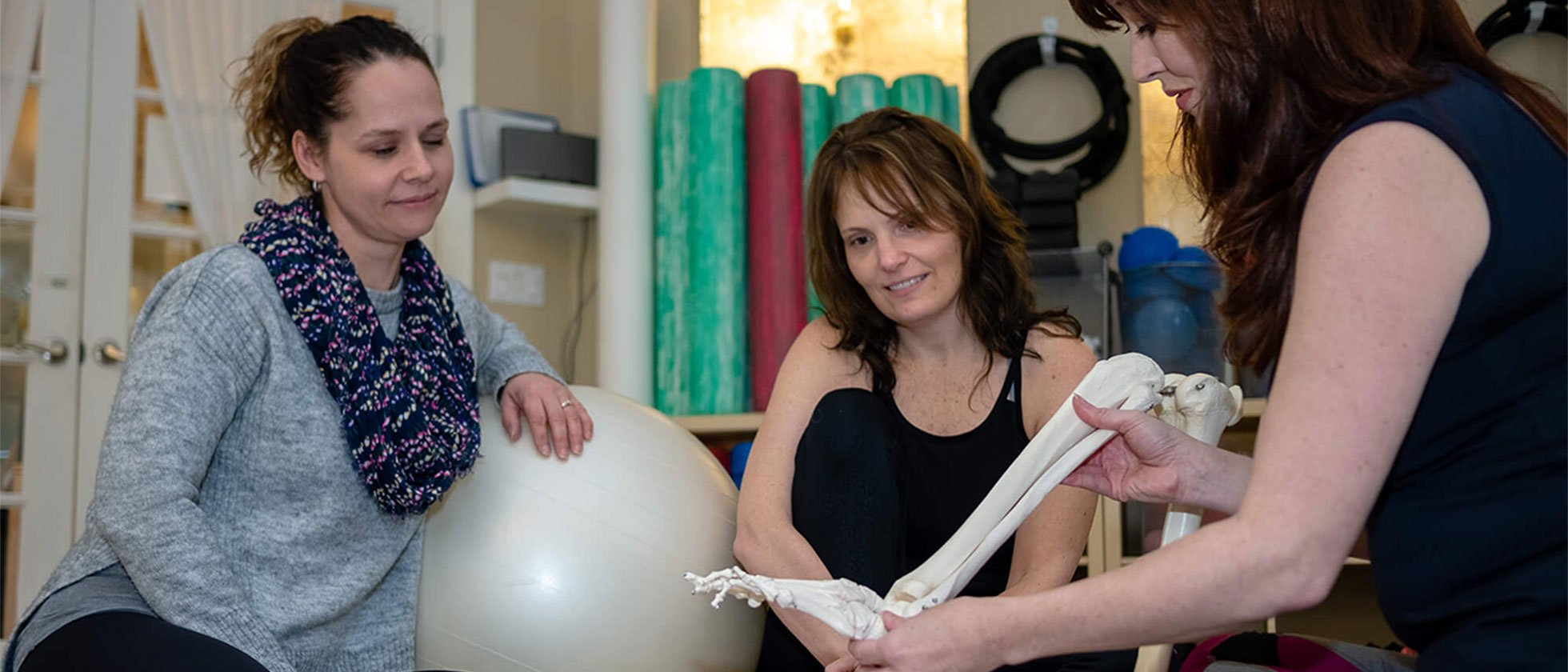
Anatomy for Motion literally changes the way you think about, observe and feel human movement. Fun and interactive, this course brings the human structure to life. You gain new insights into how the body moves from different perspectives. The ultimate goal of this course is to help you understand how movement is produced at all major joints. This understanding lays the groundwork for accurate neuromuscular recruitment, joint mobility and core control.
Learning Objectives
Explore human anatomy in 3-D
Sense and feel parts of the body as structural anatomy comes to life and takes on personal meaning
Learn foundational exercises to facilitate and optimize functional movement in the spine and major joints of the body
Simplifying the Shoulder Complex
CECs: 3 | Tuition: $140
The shoulder complex is exactly that; complex! In this foundational biomechanics course, we start with both visual and experiential reviews of the shoulder region to increase your skills of observation and assessment. You learn to identify postural deviations, imbalances, and timing incongruities that are often underlying issues in the neck and shoulder. We practise simple exercises that help integrate the shoulder complex into torso for better overall support and dynamic movement.
Learning Objectives
Review and expand your understanding of the structural anatomy of the shoulder complex
Understand how the different parts of the shoulder complex function together
Learn an exercise conditioning sequence for the shoulder complex to build optimal mechanics
*This course is one in a 3-part biomechanics series consisting of Build a Strong and Supple Spine, Power and Balance for Hip and Knee, and Simplifying the Shoulder Complex. The series explores the three major areas of the body that significantly impact overall function and focuses on how to observe movement mechanics in these areas so you can offer meaningful instruction on how to move better.
Working with Scoliosis
CECs: 6 | Tuition: $275
This course covers the characteristics of handedness and scoliosis patterns and how they affect posture and muscle activation throughout the body. You also learn how to apply this knowledge to choosing effective exercise protocols. You leave with fresh observation skills and a new paradigm of understanding spinal mechanics and their influence on both structure and function.
Learning Objectives
Learn to assess handedness patterns and their effect on human movement
Learn to assess scoliotic patterns and their effect on human movement
Apply anterior/posterior balancing and asymmetrical conditioning to address muscular imbalances
Gait Analysis
CECs: 6 | Tuition: $275
In this course you learn to analyze locomotion patterns that work from our feet, through the legs and hips, into the pelvis, and up the spine into shoulders. Based on the Spinal Engine theory, this course helps you see the gait mechanics as a whole body experience. Your ability to observe how we walk, and understand the intricacies of how movement is integrated as we walk, expands dramatically. You leave with a completely new way of seeing bodies and a repertoire of simple exercises that have profound and positive effects on a person’s gait mechanics.
Learning Objectives
Gain an understanding of gait mechanics and its impact on functional movement
Develop the skills to effectively observe gait mechanics and identify dysfunctional patterns
Learn to make educated exercise choices to promote positive changes in the gait mechanics
Practice a repertoire of exercises that positively affect gait mechanics
Osteopenia, Osteoporosis and Orthopedic Health
CECs: 6 | Tuition: $275
Today osteoporosis is reaching epidemic levels. This presents a challenge from a movement, strength and flexibility perspective. As movement and exercise professionals we need to choose appropriate exercises that keep people safe and reduce risk factors associated with osteopenia and osteoporosis. This course is packed with current information and analysis of these conditions. It also offers a detailed map of how to ensure the exercises you teach are bone safe and effective for building bone density. You leave equipped with tools to work proactively with the specialized needs of people with osteopenia and osteoporosis.
Learning Objectives
Understand the risks associated with osteopenia and osteoporosis
Learn safety protocols when working with clients who have osteopenia and osteoporosis
Learn how to make educated exercise choices for bone safety and health
Experience appropriate exercises to promote bone health and safe movement
Rehabilitative Exercise: Principles and Application
CECs: 6 | Tuition: $275
In this course, you learn principles of rehabilitative exercise and how to use these for therapeutic interventions that complement your Pilates and movement practice. You will leave knowing how to restore the greatest degree of function in the shortest time, and how to develop rehabilitation programs within the Pilates context that are appropriate for any client. Key concepts include: co-contraction, load, mechanical loading, mobility, motor control and motor skill learning, physical stress, progression, proprioception, stability.
Learning Objectives
Understand how tissues respond to physical stress and mechanical loading
Clearly identify and map the stages of exercise rehabilitation
Learn to design and assess progressive programs appropriate for any client recovering from injury
Movement and Exercise for Inflammatory and Autoimmune Diseases
DATE TO BE ANNOUNCED
In this course, you learn principles of rehabilitative exercise and how to use these for therapeutic interventions that complement your Pilates and movement practice. You will leave knowing how to restore the greatest degree of function in the shortest time, and how to develop rehabilitation programs within the Pilates context that are appropriate for any client. Key concepts include: co-contraction, load, mechanical loading, mobility, motor control and motor skill learning, physical stress, progression, proprioception, stability.
Learning Objectives
Learn what inflammatory and auto-immune disorders are
Find out how these disorders limit movement and function
Practise strategies and exercises appropriate for clients with these types of conditions
Post-Rehab Protocols: Hip and Knee
DATE TO BE ANNOUNCED
We start with a review of the structural anatomy of the hip and knee, plus all the muscles that wind from pelvis down to knee. Then we move on to examine which muscles are local and global and how to apply this information to movement patterns for hip and knee. We also review subjective and objective evaluations of all the compartments of the lower limb with primary focus on two main functions of sit to stand and gait. Finally, we dive into common conditions of the pelvis, hip and knee, as well as 11 specific movement impairment syndromes related to the pelvis and hips. Ultimately, the goal is to leave with a plan of action to restore movement, strength and function in the pelvic-hip-knee region of the body.
Learning Objectives
Gain a systematic and in-depth understanding of the lower limb
Learn both methodical and creative ways to approach movement impairments in the pelvis, hip and knee
Explore a variety of exercises that go beyond the Pilates repertoire, and push the envelope in terms of restoring optimal function and movement
*This course is part of a series of post-rehab protocol courses for the spine, hip and knee and shoulder complex. The curriculum includes functional anatomy, assessment, critical reflection, and a step-by-step program design with innovative exercises using mat, small props and Pilates machines. The series is key for any teacher searching for new ways to observe movement patterns and offer targeted exercises. The three courses in the series can be taken individually or in any sequence.
How to Help the Hypermobile Body
DATE TO BE ANNOUNCED
“Experts estimate that up to 10% of the general population may have some degree of hypermobility. Most hypermobile people do not develop any problems from their loose joints, but some suffer chronic pain and other symptoms.” (A. Pocinki, MD, Joint Hypermobility and Joint Hypermobility Syndrome, 2010)
In this course, we start by investigating what hypermobility is, its causes and who is affected. We also review clinical assessments used to determine joint hypermobility, joint hypermobility syndrome and more. We then turn to the symptoms and the dos and don’ts of helping someone manage the condition with safe and effective physical conditioning best practices.
Learning Objectives
Discover what hypermobility is, its causes and who is affected
Review clinical assessments used to determine the condition
Learn the dos and don’ts when working with a hypermobile client
“Caitlin is excellent. She explains clearly, answers all questions without judgment, offers positive criticisms and encouragement”
“I really enjoy learning from Caitlin. She makes you feel confident and pushes you to always do your best and that support feel great.”
“Caitlin’s depth of personal and professional experience makes her a confident and engaging presenter.”
Enroll Today
Our Body Harmonics Pilates Teacher Training program provides individuals with the knowledge, skills, and techniques necessary to become a certified and successful Pilates instructor.
For other courses or to request a course, please contact caitlin@pilatesinguelph.com. Most BODY HARMONICS’ continuing education courses can be taught in Guelph in the private tutorial format